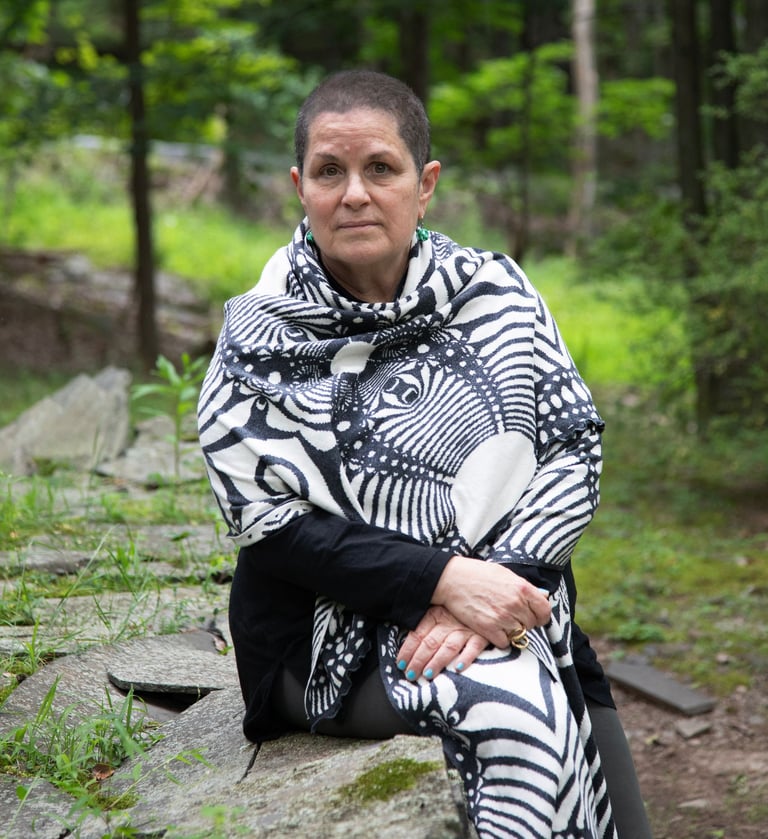
Photograph by Don Freeman
BIO/ARTIST STATEMENT
BIO
Raghubir Kintisch (b. 1955, New York, NY) is a multidisciplinary artist exploring the intersection of spiritual and creative practices. Their richly textured oil paintings on paper emerge from collage and pattern-based sketches, reflecting themes of alternative universes, nature, and the inner mind. Kintisch holds a BFA in Painting from the Rhode Island School of Design and an MFA in Social Practice from Otis College of Art and Design.
Kintisch exhibited at MoMA (2017–2018 Club 57: Film, Performance, and Art in the East Village, 1978–1983), La Foret Museum (Tokyo), Launch Gallery, LAXART, Keystone Art Gallery, Robert Berman Gallery, Merry Karnowsky Gallery, Armory Center for the Arts, Winslow Garage, Kleinert-James Gallery (Woodstock, NY), Proxy Gallery, MutMuz Gallery, Angels Gate Cultural Center, and Tryst Art Fair (Torrance), among others. A Byrdcliffe Artist-in-Residence for four consecutive years from 2022–2025, Kintisch received Pollock-Krasner Foundation funding in 2023 and was awarded a Silver Sun Foundation Residency in 2021. Recent works include diptychs, triptychs, mixed-media collage, and India ink tonal paintings, featuring vibrant color, texture, and patterning. Kintisch lives and works in Los Angeles, CA.
ARTIST STATEMENT
My paintings follow a very prescribed method of production, rooted in repetition, iteration, and transmutation. I usually begin with a somewhat figurative painting, or a collage assembled from drawings or photographs I have taken. Once the painting is complete, I photograph it and then cut the image apart--sometimes by hand, sometimes digitally--and reassemble the fragments into multiple new compositions. In some cases, I work with the entire image; in others, I isolate and enlarge small sections until they take on a life of their own.
I then paint from these altered images, essentially painting from the reassembled painting itself. In that translation, something important happens. The painted texture of the original surface, the distortion created through repeated photography, enlargement, cropping, and recombination, and the inevitable loss and simplification of detail all begin to push the work further into abstraction. Information is filtered and condensed each time the image is repainted. Certain forms become exaggerated while others disappear entirely.
This process produces unexpected relationships and accidents, which is one of the most rewarding parts of the work for me. Scale shifts alter the emotional weight of things; minor details suddenly become dominant structures. Colors begin to behave differently. Forms echo, collapse, mirror, and dissolve into one another. What begins as something simply observed gradually transforms into something psychological, atmospheric, and in motion.
What interests me most is how a single image can continually regenerate itself; how each version carries traces of the one before it while becoming something entirely different. For me, this process parallels a spiritual or self-realization practice, where experience is continually broken down, reflected upon, reconstructed, and transformed. With each iteration, something unnecessary falls away while something essential becomes more visible. The paintings are not attempts to arrive at a fixed image, but to allow the work to evolve naturally beyond self-consciousness, mirroring the unpredictable and off-road quality of the trance state. Painting, for me, therefore, is not only a visual practice but a spiritual one. Ultimately, I see this work as an inquiry into how abstraction can serve as a form of mysticism and a way of accessing what lies beyond the visible or knowable.